Today is a very special day for Germany since there happend not one but two totally different incidents in the past. On November 9th 1938 was one of the worst days in history, the Kristallnacht. 51 years later in 1989 the Berlin Wall was torn down.
Facts about November 9th in Germany
First the bad night: The Kristallnacht was a horrible event in the rise of Hitler were the Nazi leaders unleashed a series of progroms against jews. It’s called night of broken glass due to the devastating vadalism of Jewish-owned businesses. Terror and (religous) wars are more present and complex than ever and I don’t want to take sides with this.
My point is, we should never forget the horrible things that happend in the past and never let something like that happen again to anyone. [cf. encyclopedia.ushmm.org/kristallnacht]
Now the good night: 34 years ago today the Berlin Wall between East (German Democratic Republic) and West (Federal Republic of Germany) came down in a peaceful revolution [cf. (German) www.lpb-bw.de]. I would speculate that the past event maybe had something to do with the revolution. The day is definitly a reminder for war and peace at the same time, I really like that contradiction that a date of war now also symbolizes somewhat of a peaceful change for ones.
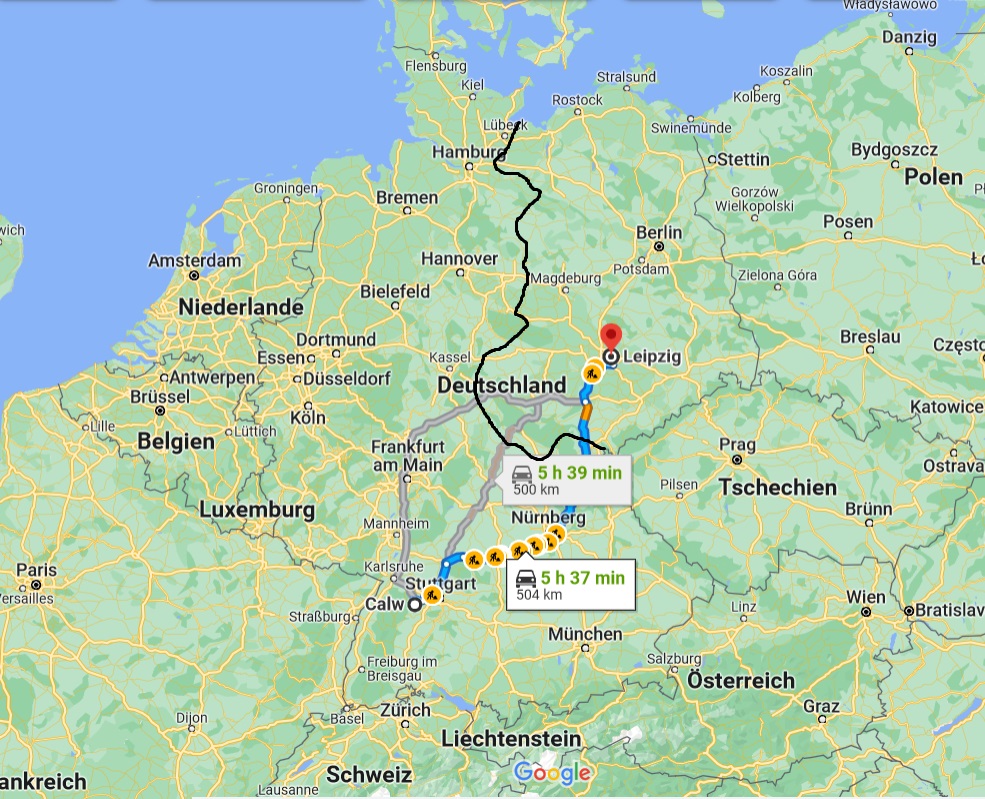
I’m born in the West (Backnang), but lived seven years in the East (Leipzig). Today I live in the West (Calw) again, but persumably will move back to Leipzig in the future cause of Him.
I’m too young to have first-hand insights into the reunification of Germany, but want to talk about some stereotypes that are still circulating. In the map you see how far Him & I live apart and in black I tried to paint the old border between East and West Germany.
A big problem for the unified society is that the East is older and there are fewer people cause there is a migration happening from East to West [cf. www.destatis.de/EN]. I think one reason for that is that there are more companies in the West, so you have more job opportunities. And because there are more people more companies settle in the West, it is a vicious circle.
Personal stories about East and West Germany today
I think that there are still big consequences from the divide of Germany and I’m not the only one. In an article 2020 the immigrant author talked to people from everywhere and the stereotypes the people are facing as well as some fact about differences in the population. For example she says that there is indeed a more unfavorable view of muslims and jews in the East [cf. www.dw.com/en].
But I lived seven years in Leipzig and had a study group with three boys who were born in Leipzig and Bernburg. I would say their political views are left to slightly conservative and also liberal, but nevertheless one of them had the impression that it is cut and dried with your geographical hometown which political side your on in the eyes of others. So that wherever you are from political and geographical you think the others are your enemy on the other side. But I can tell you I know people from both ends of the political spectrum out of both cardinal points (yes, I like to listend to different point of views a lot).
Another very personal experience was with some people from Saxony-Anhalt. They said that the DDR taught the East to value things more and that the West always thinks about money. Furthermore they thought the people in the West in fact earn more money, but the East is working harder. That is of course a very dramatic and personal point of view, but it’s the fire for the still burning divide after 34 years.
And I think of course due to the conflicted past of the 9th of November, it isn’t a holiday. But a lot of people on Facebook or Newsmagazines post about it each year to let the events never be forgotten. Another thing to help remember the past is the intiative “Stolpersteine” (Stumble bricks) before homes of Jews who died or had to leave there home during World War two with names, dates and a description of their fate [cf. www.bpb.de German].
A more funny thing about the divide is of course the language barrier between Saxon and Swabian. In Baden-Württemberg we say the phrase “Heb mal” and mean, hold tight and steady. In Saxony it means to lift the thing up. That made for some confusion for a colleague of mine who came from Saxony to Baden-Württemberg.
- Where do you live, where do you come from?
- Have you heard of one or both events?
- What is your experience and thoughts about the divide?
I’m happy to receive your feedback in German or English.
Stay tuned, Stay curious, Stay healthy.


Leave a comment